SHOP SAMSARA
IMDb >
Samsara (2001)
Quicklinks
Top Links
trailers and videosfull cast and crewtriviaofficial sitesmemorable quotesOverview
main detailscombined detailsfull cast and crewcompany creditstv scheduleAwards & Reviews
user commentsexternal reviewsnewsgroup reviewsawardsuser ratingsparents guiderecommendationsmessage boardPlot & Quotes
plot summaryplot synopsisplot keywordsAmazon.com summarymemorable quotesFun Stuff
triviagoofssoundtrack listingcrazy creditsalternate versionsmovie connectionsFAQOther Info
merchandising linksbox office/businessrelease datesfilming locationstechnical specslaserdisc detailsDVD detailsliterature listingsNewsDeskPromotional
taglines trailers and videos posters photo galleryExternal Links
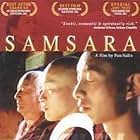
showtimesofficial sitesmiscellaneousphotographssound clipsvideo clipsSamsara (2001)
| Photos (see all 2 | slideshow) |
Overview
Release Date:
9 May 2002 (Hong Kong) moreTagline:
What is more important: satisfying one thousand desires or conquering just one...Plot:
A spiritual love-story set in the majestic landscape of Ladakh, Himalayas. Samsara is a quest; one man's... more | add synopsisAwards:
2 wins & 1 nomination moreUser Comments:
India is not Tibet moreCast
(Credited cast)| Shawn Ku | ... | Tashi | |
| Christy Chung | ... | Pema | |
| Neelesha BaVora | ... | Sujata | |
| Lhakpa Tsering | ... | Dawa | |
| Tenzin Tashi | ... | Karma | |
| Jamayang Jinpa | ... | Sonam | |
| Sherab Sangey | ... | Apo | |
| Kelsang Tashi | ... | Jamayang | |
| Tsepak Tsangpo | ... | Chen Tulku | |
| rest of cast listed alphabetically: | |||
| Jampa Kalsang Tamang | ... | Wedding Singer | |
Additional Details
MPAA:
Rated R for strong sexuality and some nudity.Parents Guide:
Add content advisory for parentsRuntime:
Argentina:138 min | Germany:145 min | USA:138 minColor:
ColorAspect Ratio:
2.35 : 1 moreSound Mix:
Dolby DigitalCertification:
India:A | Iceland:L | South Korea:18 | Argentina:16 | Singapore:R21 | Australia:MA | France:U | Germany:12 | Hong Kong:III | Netherlands:12 | Sweden:7 | Switzerland:12 (canton of Geneva) | Switzerland:12 (canton of Vaud) | Switzerland:14 (canton of the Grisons) | USA:RFilming Locations:
Ladakh, Jammu & Kashmir, IndiaMOVIEmeter: 
Fun Stuff
Goofs:
Tashi blows up a stick of wood he is using to light butterlamps. Tibetan people don't blow on flames, since this is regarded as damaging to your health. moreQuotes:
Apo: [his last letter to Tashi] I realize now that my task is not over, and so I will be returning to Samsara. I know that we shall meet again. Perhaps when we do you will be able to tell me what is more important: satisfying one thousand desires or conquering just one. moreSoundtrack:
Bumblebee moreFAQ
This FAQ is empty. Add the first question.more
Message Boards
Discuss this title with other users on IMDb message board for Samsara (2001) moreRecommendations
If you enjoyed this title, our database also recommends:
Show more recommendations
![]() |
![]() |
![]() |
![]() |
![]() |
| Bom yeoreum gaeul gyeoul geurigo bom | Excalibur | Milarepa | Kama Sutra: A Tale of Love | Batman Begins |
|
IMDb User Rating:
|
IMDb User Rating:
|
IMDb User Rating:
|
IMDb User Rating:
|
IMDb User Rating:
|
Related Links
| Full cast and crew | Company credits | External reviews |
| IMDb Adventure section | IMDb France section | Add this title to MyMovies |


I have read all the comments on this film here and I was surprised one more time to see how differently people react to one and the same film. What struck me also was that some of the viewers clearly mistake Tibet for India, because apparently they don't know that there are Buddhists in India as well.
Buddhism has its origins in Hinduism itself as it is believed that Buddha is a reincarnation of lord Vishnu The Preserver, one of the three main Hindu gods. But through the centuries Buddhism slowly developed as an independent religion. The film was shot in Ladakh which is in the Indian Himalayas, not in Tibet and two of the characters go to the town of Leh which is the capital of Ladakh and hence it is also in India. I thought that it is important to clarify these details as I don't think that one should mistake Tibet for India. India is not just Bollywood and as a country living under the phrase "unity in diversity" it surely has lots of different religious communities and lots of different cultures.
As for the film itself - I loved it, not only because it has been so beautifully shot (by the Bulgarian D.P. Rali Ralchev) and not only because it meets us with a part of the world we barely know, but mostly because I could identify with the characters and their desires, anguish, pain, joy, dreams. "Samsara" (the Hindu concept of reincarnation) asks some philosophic questions in a very earthly manner, I think. The ideas of Buddhism, the detachment from earthly life in order to reach enlightenment, the conquering of ourselves, our ego, our earthly desires (to love, to have family, to enjoy the simple but earthly life of a farmer, to possess objects and to command love from the others) are ideas or rather dilemmas that many of us face from time to time. Buddha has said that the middle way is the right way to follow, but how can this way be found? Is it through experiencing the earthly life, then renouncing it and then devoting oneself to the life a monk, choosing the spiritual life in search of the almighty truth and the great soul? This was the way Buddha has chosen - being a prince himself, having a family, and then renouncing it and devoting himself to the life of a recluse, but of a recluse who has reached the enlightenment and a recluse willing to share the truth with the others.
Everyone chooses one's own way. Tashi is a person who asks himself questions and he's a person who searches for his own right path. To say that he is only an egoist who leaves his wife when he gets fed up the life of a family man and a farmer is quite simplistic, I think. I believe he has been very honest from the beginning to the end and that is why he left the monastery at first and came back to it in the end. The important idea that I have discovered was that no matter what kind of path one will choose there will always be an anguish along the way. Maybe it is because of the eternal question unanswered - what to choose - to satisfy all desires or to conquer the one and only? No matter what we choose we will always doubt from time to time that maybe we should have chosen the opposite.
What I really liked about this film also is the fact that it presented us with the female point of view in the final monologue of Tashi's wife Pema. She was given no choice from him when he decided to go back to the monastery. She had to stay behind and take care of their son. She was shown to us as the keeper of the traditions (not allowing her son to play with the modern toy his father bought him from Leh) but at the same time she had that free spirit to make love to the unknown Lama and afterward to even marry him. I liked the sensitivity of the writer / director who cared not only to show us the pain of Pema when realizing she's losing his husband, but also to make her an intelligent woman who thinks and who turns out be as wise and devoted as her Lama husband.