SHOP NINETEEN...
IMDb >
Nineteen Eighty-Four (1984)
Quicklinks
Top Links
trailers and videosfull cast and crewtriviaofficial sitesmemorable quotesOverview
main detailscombined detailsfull cast and crewcompany creditstv scheduleAwards & Reviews
user commentsexternal reviewsnewsgroup reviewsawardsuser ratingsparents guiderecommendationsmessage boardPlot & Quotes
plot summaryplot synopsisplot keywordsAmazon.com summarymemorable quotesFun Stuff
triviagoofssoundtrack listingcrazy creditsalternate versionsmovie connectionsFAQOther Info
merchandising linksbox office/businessrelease datesfilming locationstechnical specslaserdisc detailsDVD detailsliterature listingsnews articlesPromotional
taglinestrailers and videospostersphoto galleryExternal Links
showtimesofficial sitesmiscellaneousphotographssound clipsvideo clipsNineteen Eighty-Four (1984)
| Photos (see all 8 | slideshow) |
Overview
Release Date:
14 December 1984 (USA) moreTagline:
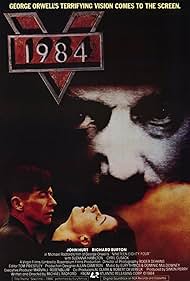
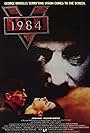
George Orwell's Terrifying Vision Comes To The Screen. morePlot:
George Orwell's novel of a totalitarian future society in which a man whose daily work is rewriting history tries to rebel by falling in love. full summary | full synopsis (warning! may contain spoilers)Awards:
Nominated for BAFTA Film Award. Another 6 wins & 1 nomination moreUser Comments:
"We shall meet in the place where there is no darkness..." moreCast
(Cast overview, first billed only)| John Hurt | ... | Winston Smith | |
| Richard Burton | ... | O'Brien | |
| Suzanna Hamilton | ... | Julia | |
| Cyril Cusack | ... | Charrington | |
| Gregor Fisher | ... | Parsons | |
| James Walker | ... | Syme | |
| Andrew Wilde | ... | Tillotson | |
| David Trevena | ... | Tillotson's Friend | |
| David Cann | ... | Martin | |
| Anthony Benson | ... | Jones | |
| Peter Frye | ... | Rutherford | |
| Roger Lloyd-Pack | ... | Waiter (as Roger Lloyd Pack) | |
| Rupert Baderman | ... | Winston as a Boy | |
| Corinna Seddon | ... | Winston's Mother | |
| Martha Parsey | ... | Winston's Sister |
Additional Details
Parents Guide:
View content advisory for parentsRuntime:
113 minCountry:
UKLanguage:
EnglishColor:
Color (Eastmancolor)Aspect Ratio:
1.66 : 1 moreSound Mix:
MonoCertification:
Iceland:16 | Canada:R (Manitoba/Nova Scotia/Ontario) | Argentina:16 | Australia:M | Finland:K-16 | Netherlands:12 | Norway:18 (1984) | Sweden:15 | UK:15 | USA:R | West Germany:16 | Canada:13+ (Quebec)MOVIEmeter: 
Fun Stuff
Trivia:
The film won the Best British Film of the Year award at the Evening Standard British Film Awards. moreGoofs:
Crew or equipment visible: When Mr. Charrington is showing Winston the print in the upstairs room, he briefly raises the oil lantern high enough to reveal an electrical cord extending from it. moreQuotes:
[first lines]Big Brother: [voiceover] This is our land. A land of peace and of plenty. A land of harmony and hope. This is our land. Oceania. These are our people. The workers, the strivers, the builders. These are our people. The builders of our world, struggling, fighting, bleeding, dying. On the streets of our cities and on the far-flung battlefields. Fighting against the mutilation of our hopes and dreams. Who are they?
more
Soundtrack:
Julia moreFAQ
This FAQ is empty. Add the first question.more
Message Boards
Discuss this title with other users on IMDb message board for Nineteen Eighty-Four (1984) moreRecommendations
If you enjoyed this title, our database also recommends:
Show more recommendations
![]() |
![]() |
![]() |
![]() |
![]() |
| Brazil | V for Vendetta | The Running Man | Fahrenheit 451 | THX 1138 |
|
IMDb User Rating:
|
IMDb User Rating:
|
IMDb User Rating:
|
IMDb User Rating:
|
IMDb User Rating:
|
Related Links
| Full cast and crew | Company credits | External reviews |
| IMDb Drama section | IMDb UK section | Add this title to MyMovies |


Michael Radford's utterly superlative film of Orwell's famed novel may well be the greatest cinematic adaptation of a major literary source ever -- and it stands out as one of the most memorable British films of the past thirty years. Full credit is due to cinematographer Roger Deakins who shoots everything in grainy, washed-out, desaturated colors adding to the picture's atmosphere of wistful yet austere, dream-like strangeness. The modern London settings -- with their cobblestone streets, shabby, dilapidated buildings, desolate fields, rubble-strewn alleyways, and forbidding, blackened Gothic-Victorian façades and hints of minimalist fascist architecture -- resemble a Depression-era housing project after the Luftwaffe. And Dominic Muldowney's score, with its martial clarion calls, bombastic church-organ blasts, and swelling choral leitmotiv of `Oceania, 'tis for thee,' has a mixture of Wagnerian grandeur and Bach-like religiosity about it. All the while, the bizarre, mantra-like drones of the much-maligned Eurythmics soundtrack rises and falls, weaving in and out of the narrative like so many subconscious banshee wails.
Radford treats the book's premise not as a sci-fi flight of fantasy or grim prophecy but rather as the world of 1948 seen through a glass darkly -- a kind of medieval morality play for the post-totalitarian age. There is less emphasis on the novel's musty, well-worn-and-endlessly-picked-over polemical import and more focus on the stark human element, and indeed, the actors bear such uncanny resemblance to Orwell's descriptions they practically seem born for their roles.
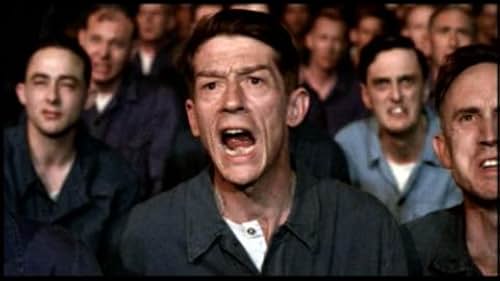
With his quiet, brooding eloquence and haunted eyes peeking out of a gaunt, cadaverous frame like a tubercular, ashen-faced Egon Schiele figure, John Hurt is ideally cast as Winston Smith. As Julia, Suzanna Hamilton (first seen as a lovelorn dairymaid in Polanski's TESS and as the paralyzed daughter in BRIMSTONE AND TREACLE) has a serene, arresting presence and she appears as mysteriously stirring and beguiling to us as she does to Hurt. She brings a captivating freshness and warmth to her role, a little reminiscent of a young Harriet Andersson. Her pale, wiry, broad-hipped body has a simple, unaffected, almost archetypal beauty, and in the film's more intimate moments, she radiates all the tactile sensual grace of a Munch or Degas nude.
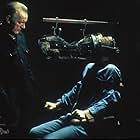
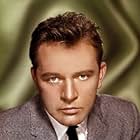
As O'Brien, the Jesuitical inquisitor of infinite patience, Richard Burton delivers a superbly perspicacious swan-song performance he becomes almost a kind of an oracular Thanatos to Hamilton's Eros. In an exquisite, maliciously Swiftian twist of irony, Burton's famous voice, with its rich, mellifluous Welsh inflections and descending cadences of Shakespearean sonnets and Dylan Thomas poetry, becomes a cruel herald of the willful, systematic destruction of the human spirit -- of `the worst thing in the world' that waits in Room 101 in the fated `place where there is no darkness.' When O'Brien tells Winston, `you are thinking that my face is old and tired and that while I talk of power I am unable to prevent the decay of my own body,' Burton's sagging, weary face speaks volumes.
In the lesser roles, Gregor Fisher's Parsons literally resembles a sweaty frog, James Walker's Syme is the classic image of a squirrelly, mealy-mouthed hack-intellectual, while Andrew Wilde cuts the most chilling figure as the bespectacled, unblinking company man,' Tillotson. The late Cyril Cusack plays Mr. Charrington, the kindly Cockney landlord who is not all that he appears to be, with an understated sentimental charm punctuated by slight flickers of calculating menace (watch closely for the way Cusack's facial expression changes whenever Hurt is not looking at him). Phyllis Logan (the star of Radford's début feature, ANOTHER TIME, ANOTHER PLACE, and a supporting player in Mike Leigh's SECRETS AND LIES) provides one of the film's most clever unacknowledged ironies: as the Telescreen Announcer, her strident, hectoring voice suggests a more shrill caricature of Margaret Thatcher.
If anything, this film makes a unique and compelling case for some of the oldest cinematic devices in the book that nearly all contemporary filmmakers have since abandoned: slow dissolves, fades, blackouts, shock-cuts, slow motion, flashbacks, montage. The high-contrast photography, alternately harsh and low-key lighting, and iconic close-up shots evoke the abstract, transcendental purity of Bresson or Dreyer. There is even one extraordinary sequence when Winston, bruised and battered, is seen having his head shorn in a holding cell that is clearly meant to recall Falconetti's famous haircutting scene in Dreyer's LA PASSION DE JEANNE D'ARC (1928). Similarly, Burton is filmed in oppressive, looming low-angle with Expressionist shadows defining the lines of his craggy visage à la Eugène Silvain's Bishop Cauchon sans the warts. And the idyllic barley fields of the Golden Country,' where Winston and Julia have their first tryst is a possible homage to the titular peasant paradise of Dovzhenko's EARTH (1926).
What makes the film so powerful is not merely its fidelity to its source but its vivid sense of realism. NINETEEN EIGHTY-FOUR is such an impassioned and richly textured work that the visuals almost seem to seep into the pores of your skin, intoxicating you with dread and longing. And Radford is so adept at obscuring the boundaries that separate the ameliorative persistence of reverie from the glaring harshness of waking reality, that the film's seamless perfection becomes almost frightening.