SHOP STRADA, LA
IMDb >
Strada, La (1954)
Quicklinks
Top Links
trailers and videosfull cast and crewtriviaofficial sitesmemorable quotesOverview
main detailscombined detailsfull cast and crewcompany creditstv scheduleAwards & Reviews
user commentsexternal reviewsnewsgroup reviewsawardsuser ratingsparents guiderecommendationsmessage boardPlot & Quotes
plot summaryplot synopsisplot keywordsAmazon.com summarymemorable quotesFun Stuff
triviagoofssoundtrack listingcrazy creditsalternate versionsmovie connectionsFAQOther Info
merchandising linksbox office/businessrelease datesfilming locationstechnical specslaserdisc detailsDVD detailsliterature listingsnews articlesPromotional
taglinestrailers and videospostersphoto galleryExternal Links
showtimesofficial sitesmiscellaneousphotographssound clipsvideo clipsStrada, La (1954)
| Photos (see all 18 | slideshow) |
Overview
Release Date:
16 July 1956 (USA) morePlot:
A carefree girl is sold to a traveling entertainer, consequently enduring physical and emotional pain along the way. full summary | full synopsis (warning! may contain spoilers)Awards:
Won Oscar. Another 8 wins & 4 nominations moreUser Comments:
La Strada: Fellini's masterpiece moreCast
(Complete credited cast)| Anthony Quinn | ... | Zampanò | |
| Giulietta Masina | ... | Gelsomina | |
| Richard Basehart | ... | Il 'Matto'-The 'Fool' | |
| Aldo Silvani | ... | Il Signor Giraffa-Mr Giraffe | |
| Marcella Rovere | ... | La Vedova-The Widow | |
| Livia Venturini | ... | La Suorina-The Sister |
Additional Details
Parents Guide:
Add content advisory for parentsRuntime:
108 minCountry:
ItalyLanguage:
ItalianColor:
Black and WhiteSound Mix:
Mono (Western Electric Recording)Certification:
Portugal:M/12 | Argentina:16 | Australia:G | Australia:M (alternate rating) | Chile:18 | Finland:K-10 (1986) | Finland:K-16 | Norway:16 | Sweden:15 | Switzerland:16 (canton of the Grisons) | West Germany:16 | Singapore:PG | Norway:15 (1995) | UK:PG (video rating) | UK:A (original rating)MOVIEmeter: 
Fun Stuff
Trivia:
Anthony Quinn said in an interview a few years before his death that he originally accepted a deal that would have paid him a percentage of the profits this film generated instead of an upfront salary. When his agent found out about it, the agent changed the deal and insisted an upfront salary and no percentage. Quinn said that decision cost him several million dollars. moreGoofs:
Continuity: When Zampanò meets the Fool while he is repairing a flat tire on his car, the left front wheel is removed and the car is jacked. Right after the altercation, when Zampanò pushes the Fool's car, the wheel rim is back and not jacked anymore. moreQuotes:
The Fool: I am ignorant, but I read books. You won't believe it, everything is useful... this pebble for instance.Gelsomina: Which one?
The Fool: Anyone. It is useful.
Gelsomina: What for?
The Fool: For... I don't know. If I knew I'd be the Almighty, who knows all. When you are born and when you die... Who knows? I don't know for what this pebble is useful but it must be useful. For if its useless, everything is useless. So are the stars!
more
FAQ
This FAQ is empty. Add the first question.more
Message Boards
Discuss this title with other users on IMDb message board for Strada, La (1954) moreRecommendations
If you enjoyed this title, our database also recommends:
Show more recommendations
![]() |
![]() |
![]() |
![]() |
![]() |
| Vitelloni, I | Heaven | Giulietta degli spiriti | Alice Doesn't Live Here Anymore | Notti di Cabiria, Le |
|
IMDb User Rating:
|
IMDb User Rating:
|
IMDb User Rating:
|
IMDb User Rating:
|
IMDb User Rating:
|
Related Links
| Full cast and crew | Company credits | External reviews |
| News articles | IMDb top 250 movies | IMDb Drama section |
| IMDb Italy section | Add this title to MyMovies |


It is the early sixties in Annapolis, Maryland. Although a Third Class Petty Officer in the Navy, I am still in my teens & have never sampled the cinema except for what Hollywood has had to offer. I have just stumbled out of a theater & I am stunned yet aware that I have just witnessed a work of art that was devoid of compromise. That work was La Strada, a cinematic creation directed by Federico Fellini. I have viewed this film several times since but it never pales & each time I take away something new. In this post I'll concentrate on the main characters & some of the cast.
Anthony Quinn was perfect for the role of Zampano, the grubby strongman performer touring the villages & countryside of post-WW2 Italy. No other actor of the day could have possibly brought what Quinn brings to the role. There may have been some European actor who would not have shamed himself in the part, but I can't think of who it might have been & certainly no actor known by Hollywood could have done so well as Quinn. One has to resort to other eras & reach far into the imagination to attempt such speculation. If Wallace or Noah Beery, sr. could have managed a not too corrupted Italian persona; perhaps. If Gilbert Roland had lifted weights & taken supplements for a year; maybe. Victor McLaglen could never have passed for Italian don't laugh he had the rugged looks & the physique. Ricardo Montalban? Too handsome. Ditto, Victor Mature. Mitchum was way too 'American.' Nehemiah Persoff, Eli Wallach, Telly Savalas, Rod Steiger, Karl Malden, even Van Heflin, all considered, all rejected. Brando might have been credible. One remembers "A Streetcar Named Desire" & "On the Waterfront" & thinks: Possibly. But Quinn plays the role as if it was what he was put on earth to do.
Quinn's Zampano is earthily callous yet the viewer senses vulnerability buried deep within the character. Among other facets his perfect performance presents to the viewer is a faintly perceived inkling of past disappointments, of indirectly inferred reasons that Zampano is cruel & insensitive. Quinn's consummate technique paints the broad picture of a lout yet the viewer is able to pull a slender thread of sympathy from his character & that sympathy is necessary for the end of the movie. To be very bad & to still be likable, if only barely, is produced by Quinn as if it were a gift to the viewer. It is acting on the highest possible plane.
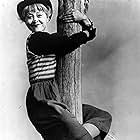
Giulietta Masina plays Gelsomina, a tattered urchin Zampano purchases from her poverty-bested mother. Here too, the viewer witnesses genius of casting. Masina's face is one of Fellini's main canvases in the film. It mugs, it displays pride, love & resignation in fleeting cascades of expression, sometimes all within a second. Even without the plasticity of her face her body alone would be enough to write volumes for the viewer. It gambols, prances, pratfalls & cunningly sneaks, sometimes at breakneck speed though the viewer's eye is never allowed to blur these perceptions despite the rapidity of much of the execution.
Richard Basehart plays the Fool, foil to Quinn's brute. Whereas Quinn's act subsists on feats of strength, Basehart's character is all about finesse: juggling, acrobatics & tightrope-walking. Zampano is awkward on those occasions that he attempts real affection toward Gelsomina. The Fool is light strokes of joviality; joking & flirting is his natural mode. Zampano's voice is gruff and in the baritone range; Basehart's lines are delivered high-pitched, with a lilting modulation. However, just as Zampano has an almost hidden vein of sensitivity, Basehart imbues his lighthearted portrayal with a close to imperceptible strand of hardness.
The vehicle of the plot is a journey, but a journey with no particular physical destination. In a work such as "Huckleberry Finn" Twain provides a direction(down-river with the current). Here the characters appear to wander aimlessly from place to place, seemingly interacting by chance with whoever they meet & somehow this very lack of goal helps to give the piece a lifelike aura of randomness. The viewer becomes unaware of watching a film. Like all truly great works of art, technique never intrudes & the viewer could be a fly on the wall.
This lack of artificiality allows the viewer to be fully immersed in the unfolding events. The landscape is the blasted Italian environment just after WW2 & is symbolic of the work's bleak message. The camera rolls on weeds, shacks, broken concrete, poorly maintained roadways, dry, desolate hinterlands & famine-ridden villages. There is no looking away allowed, the viewer is made to see, forced to behold stark realities.
It is impossible to say exactly what makes this film a masterpiece. By a mysterious & perhaps lucky combination of ingredients it propels itself into the highest circle of cinema. The end is emotionally wrenching & I would venture that few are able to leave it as I did long ago in Annapolis without a sense of having been deeply moved.